A smashed screen on Monday morning, a battery that dies by lunch, or an iPhone that suddenly refuses to charge – this is usually when the iPhone repair vs replacement question becomes urgent. Most people are not weighing up theory. They just want their phone working again, their photos safe, and the cost kept sensible.
The good news is that the right choice is often clearer than it first appears. In many cases, repair is the fastest and most cost-effective route. In others, replacement is the smarter long-term decision. The key is knowing what fault you are dealing with, how old the device is, and whether spending money now will genuinely give you more usable life from the phone.
iPhone repair vs replacement – what actually matters?
Price is the first thing most people think about, but it should not be the only one. A cheap fix is not a bargain if another major fault is right around the corner. Equally, replacing a phone too quickly can be an expensive reaction to a problem that is actually straightforward to sort.
The real decision usually comes down to five things: the value of the handset, the type of damage, the likely lifespan after repair, the urgency of getting it back, and the importance of your data. Once you look at those together, the answer tends to become much more practical.
If your iPhone is relatively recent and the problem is limited to one part – such as the screen, battery, charging port or rear glass – repair often makes strong financial sense. If the phone has multiple faults, severe board damage, or is already near the end of its useful life, replacement may be the better investment.
When repair is usually the better option
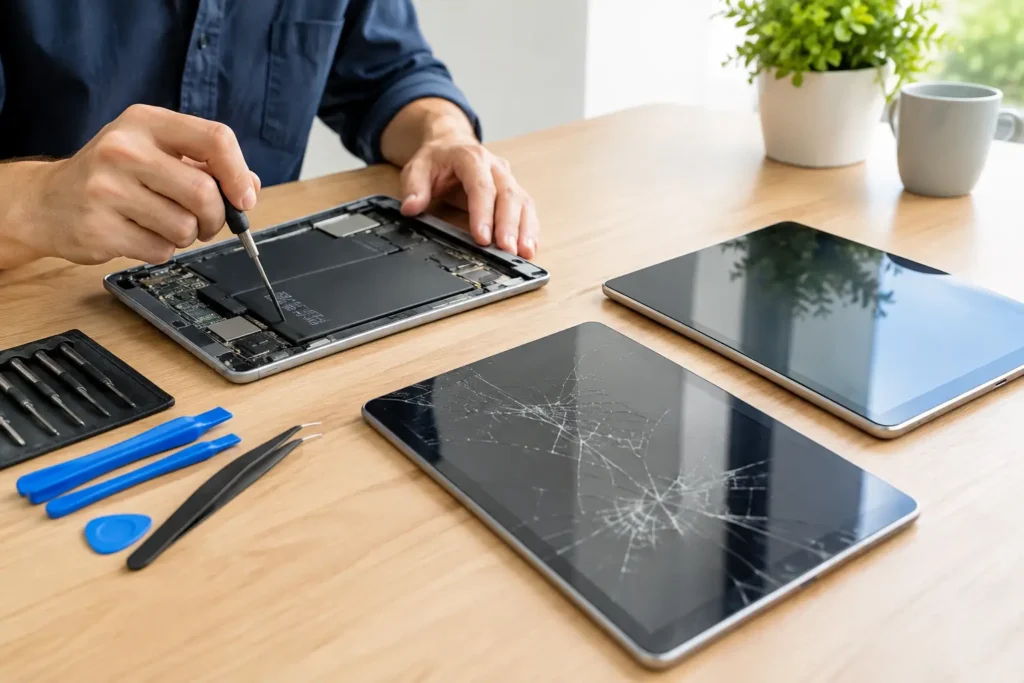
Screen damage is the most common example. A cracked display looks dramatic, but if the phone still functions normally underneath, a screen replacement is often the obvious fix. The same applies to worn batteries. If your iPhone is otherwise in good condition but drops from 40 per cent to zero with no warning, replacing the battery can make it feel reliable again without the cost of a new handset.
Charging issues also fall into this category. People often assume a phone that will not charge is finished, but the fault may be with the charging port, debris in the connector, or a small component linked to the power circuit. Those are faults worth diagnosing properly before you write the device off.
Repair also makes sense when the phone still suits your needs. If you are happy with the camera, speed and storage, there is little value in upgrading just because one part has failed. For many users, especially families, students and small businesses managing several devices, fixing a working phone is simply the more sensible option.
There is also the question of convenience. A local repair can often get you back up and running far faster than shopping for a new device, setting it up, transferring data, re-signing into apps and sorting out forgotten passwords. That downtime has a cost too, even if it does not appear on the receipt.
When replacement makes more sense
There are times when replacing your iPhone is the wiser move. If the handset has suffered major liquid damage, repeated drop damage, or a serious logic board fault, repair can become less predictable. One issue may be fixable, but if corrosion or impact has affected several components, the phone may continue to develop faults later.
Age matters as well. If your iPhone is already several generations behind and has poor battery life, limited storage, performance issues and physical damage, putting more money into it may not be worthwhile. A repair might solve one problem while leaving you with three others.
Replacement can also be the better route if repair costs start to approach a large proportion of the phone’s current value. For example, if an older handset needs both a screen and battery, and perhaps has Face ID issues or water damage on top, the total spend can quickly become harder to justify.
That said, replacement should still be a considered decision rather than a knee-jerk one. People often assume the newest phone is the only answer, when a repair on the current device could buy another year or two of solid use.
The hidden cost of replacing too soon
A lot of customers focus on the headline price of a repair versus the retail price of another phone, but there are extra costs around replacement that are easy to miss. Cases, chargers, insurance changes, setup time, and possible differences in accessories all add up. If you use your phone for work, there is also the lost time involved in getting everything back the way you need it.
Then there is data risk. Photos, messages, notes, app logins and business information can be difficult to recover if a device is badly damaged and you have not backed it up recently. In many situations, a repair is not just about saving the handset. It is about getting access back to the data that matters.
That is one reason proper diagnosis matters. A phone that seems dead may still be recoverable, and recovering the device can be far less stressful than starting again from scratch.
How to judge the fault before deciding
Not all damage is equal. Cosmetic damage, isolated part failure and intermittent charging problems are very different from widespread internal failure. A cracked screen with full touch response is one thing. A phone that bends, overheats, restarts randomly and has no mobile signal is another.
A good rule is to ask whether the issue is contained or spreading. If one clear component has failed and the rest of the phone is healthy, repair is usually worth strong consideration. If the damage affects several systems at once, replacement becomes more likely.
Battery health is another useful clue. If your only complaint is poor battery life, that is often one of the most worthwhile repairs available. If battery problems are paired with swelling, charging faults and performance drops on an ageing handset, the decision needs a wider view.
This is where a local repair specialist can save you money. A proper assessment gives you a realistic picture of what is wrong, what it will cost to fix, and whether the repair is likely to hold up well. Straight answers matter more than wishful thinking.
iPhone repair vs replacement for newer and older models
With newer iPhones, repair tends to win more often because the handset still holds good value. A current or recent model with a broken screen or weak battery is normally well worth repairing. You avoid the high cost of buying another premium phone and keep using a device that still has years left in it.
With older models, the answer is more mixed. If the phone is in decent condition and only needs one repair, fixing it can still be excellent value. If it is already sluggish, storage is full, and software support is becoming a concern, replacement starts to look more reasonable.
There is no perfect age cut-off because usage differs. Some people need top camera performance and all-day battery for work. Others just need calls, messages, maps and banking apps to run reliably. The right decision depends on what you need the phone to do next, not just how old it is.
What local customers should prioritise
If you are in Barrow-in-Furness, across Furness, or elsewhere in Cumbria, speed and trust usually matter just as much as price. Sending a device away can mean days without it, which is not ideal when your phone is how you work, study, pay for things and stay in touch.
That is why many customers choose a nearby repair service first. You get a clearer diagnosis, faster turnaround, and reassurance that your device and data are being handled properly. For schools, businesses and families with multiple devices in use, that practical benefit can outweigh the temptation to replace everything at the first sign of trouble.
At TechLab Repairs, that kind of decision is what we help with every day – not pushing replacement for the sake of it, but looking at the fault, the model and the real value of the repair.
The smartest way to make the call
If your iPhone has one main fault and still does everything you need, repair is often the best answer. If it has several serious issues, is unreliable, or the repair cost is creeping too close to the value of the handset, replacement may be the better move.
The important thing is not to guess. Get the device checked, ask what has actually failed, and weigh the repair against the phone’s realistic remaining lifespan. A good repair can save you a lot of money. A timely replacement can save you from pouring money into a device that is already on its way out.
Don’t let a broken iPhone slow you down – the right choice is the one that gets you back to a reliable phone with the least hassle, the least wasted spend, and the best chance of keeping your data safe.