One key stops responding, then another starts double-typing, and before long your MacBook feels harder to use than it should. This macbook keyboard replacement guide is here to make the next step clearer – whether you are dealing with sticky keys, liquid damage, missing caps or a keyboard that has failed completely.
For most people, the real question is not simply, “Can the keyboard be replaced?” It is, “Is it worth replacing, how much disruption will it cause, and will my data stay safe?” Those are the right questions, because MacBook keyboard repairs vary a lot depending on the model, the cause of the fault and how Apple built that particular machine.
When a MacBook keyboard replacement is actually needed
Not every keyboard fault means the whole keyboard needs replacing. Sometimes the issue is isolated to debris under a key, liquid residue causing poor contact, or damage to a single keycap and mechanism. In those cases, a targeted repair may be enough.
A full replacement becomes more likely when several keys have stopped working, the keyboard registers repeated presses, backlighting has failed alongside key input, or liquid has spread across the assembly. If the top case is bent or there is corrosion on internal layers, replacing individual parts often turns into a false economy.
This is where a proper diagnosis matters. It is easy to assume the keyboard is dead when the problem is actually linked to the trackpad cable, logic board damage or software settings. On the other hand, some MacBooks have well-known keyboard design weaknesses, and those faults rarely improve for long with a quick clean.
Why MacBook keyboard repairs are more complicated than many laptop repairs
Apple has used several keyboard designs over the years, and they are not equally simple to fix. Older MacBook models can sometimes be serviced with less dismantling. Newer models, especially those with tightly integrated top cases, often require far more labour.
On some machines, the keyboard is effectively part of a larger upper assembly. That means replacing the keyboard may involve removing the battery, speakers, trackpad and other internal parts before the technician can even get to it. In certain cases, replacing the complete top case is the more sensible route because it improves reliability and reduces the chance of repeat issues.
The butterfly keyboard era is a good example of why design matters. These keyboards were slim, but they were also more vulnerable to dust, crumbs and minor contamination. A key might feel normal one day and fail the next. Even when a single key looks like the problem, the underlying weakness can affect the rest of the keyboard later.
Common signs your keyboard fault is getting worse
A keyboard usually gives you some warning before total failure. You may notice letters appearing twice, keys needing extra pressure, shortcuts not working properly or a space bar that only responds at one side. Some users also report that the keyboard works for a while after restarting, then becomes unreliable again.
Liquid damage changes the picture. If tea, coffee or water has reached the keyboard, the fault can spread over time even if the machine appears usable at first. Corrosion does not always show itself straight away. What begins as one sticky key can develop into widespread input issues, battery problems or board-level faults later on.
If your MacBook has taken in liquid, speed matters. Turning it off and getting it checked quickly gives the best chance of limiting further damage.
DIY or professional repair?
If a single keycap has popped off and the mechanism underneath is intact, a careful refit can sometimes work. Likewise, if the issue is surface dirt around a key, gentle cleaning may help. Beyond that, DIY repair becomes risky quite quickly.
MacBook keyboards are not forgiving if you are working without the right tools or experience. Internal screws are tiny, connectors are delicate and batteries are often glued in place. A rushed home repair can turn a keyboard issue into trackpad damage, screen cable damage or a punctured battery.
The other point people often miss is data security. If your MacBook contains work files, coursework, family photos or business records, the repair process should protect the machine as a whole, not just fix the key problem. A good repair is not only about replacing parts. It is about keeping your device stable, your information secure and your downtime as short as possible.
What happens during a professional keyboard replacement
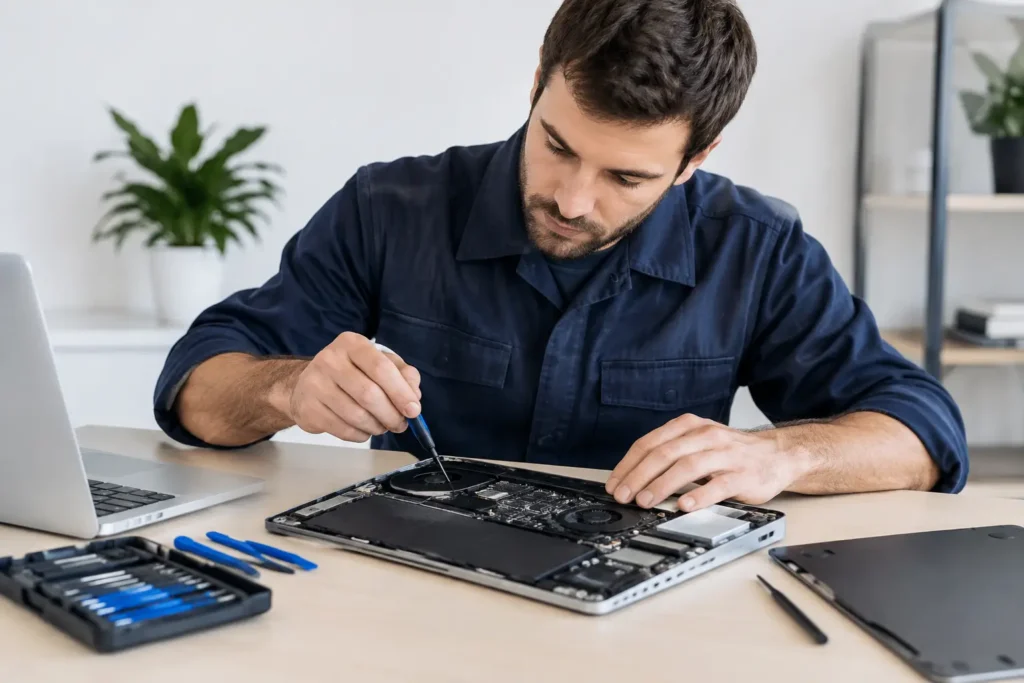
A proper keyboard repair starts with confirming the fault. The technician checks whether the issue is the keyboard assembly itself, a top case fault, liquid contamination or a board-related problem causing similar symptoms.
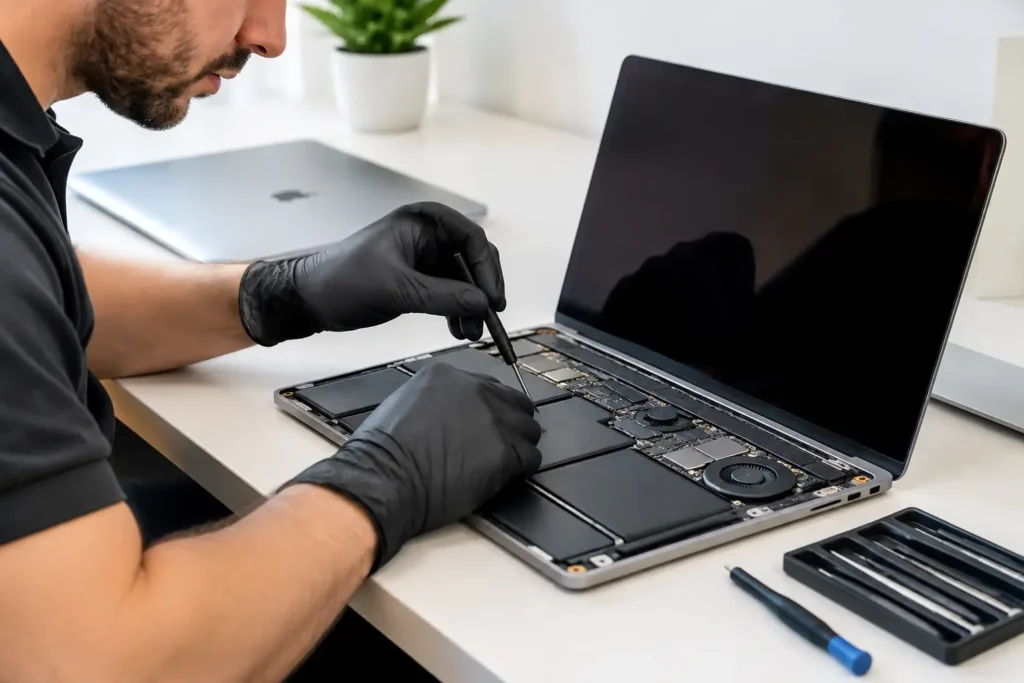
Once confirmed, the MacBook is opened and stripped down to the level required for that model. On some devices, the keyboard can be replaced on its own with substantial disassembly. On others, fitting a replacement top case is the more efficient and reliable option. After fitting the part, the keyboard is tested key by key, and related functions such as backlight behaviour, trackpad response and battery fitment are checked before the machine is closed up.
If liquid damage is involved, there may also be cleaning and corrosion treatment to carry out. That is important because fitting a new keyboard into a machine with untreated internal contamination can lead to repeat faults.
Cost, time and the factors that change both
There is no single fixed price that covers every MacBook keyboard repair. The final cost usually depends on the model, whether the repair needs a keyboard-only part or a full top case, and whether liquid damage or board work is also present.
Labour can be a major factor because some MacBooks take far longer to dismantle and rebuild than others. Newer, slimmer models often demand more time. Parts quality matters too. A cheaper part may lower the bill, but it is not always the best long-term choice if typing feel, fit or lifespan suffer.
Turnaround times also vary. A straightforward booked repair with parts available can be relatively quick. If the machine has multiple faults, hidden corrosion or model-specific part delays, it may take longer. The sensible approach is transparency from the start, so you know whether the repair is likely to be simple or more involved.
Should you repair it or replace the MacBook?
That depends on the age of the device, its overall condition and what you use it for. If the MacBook still performs well, holds charge reasonably and meets your daily needs, replacing the keyboard is often far cheaper than buying a new machine.
If the battery is failing, the screen is damaged and the keyboard has liquid damage on top, the value equation changes. At that point, it makes sense to compare the combined repair cost with the value and expected lifespan of the device after repair. For business users and students especially, the right answer is often the one that gets them back to work quickly without overspending.
This is where local, straightforward advice helps. A trustworthy repairer should tell you when a repair is sensible and when it is not. That honesty saves money and avoids frustration.
Choosing the right repair service
When looking for help with a macbook keyboard replacement guide in real life, not just on a webpage, focus on three things: diagnosis, part quality and accountability. You want a repair service that can explain what has failed, what part will be fitted and what testing will be done afterwards.
It is also worth asking how your data will be handled. Most keyboard repairs do not require access to your files, but your device should still be treated carefully and securely throughout the process. If you use your MacBook for business, school or personal admin, that peace of mind matters.
For customers across Barrow-in-Furness and the wider Cumbria area, a local repair shop such as TechLab Repairs can be the practical option because you are not sending your machine away and waiting blindly for updates. You can ask questions, get a clearer timeline and deal with people who understand that a broken laptop is not a minor inconvenience – it can stop work, study and day-to-day life.
How to avoid another keyboard problem
Some keyboard faults are design-related and hard to prevent entirely, but a few habits do help. Keep drinks well away from the MacBook, avoid eating directly over the keyboard, and do not force sticky keys. If you use a protective cover, make sure it is suitable for your model and does not interfere with screen closure or key movement.
Regular light cleaning is sensible, but be careful. Too much moisture or the wrong cleaning method can create a new problem rather than solve the old one. If keys start behaving oddly, get the issue checked sooner rather than later. Small faults are often easier and cheaper to deal with before they spread.
A faulty keyboard can make a good MacBook feel unusable, but it does not always mean the whole machine is finished. The right repair starts with the right diagnosis, and that is what turns guesswork into a clear, cost-effective fix.