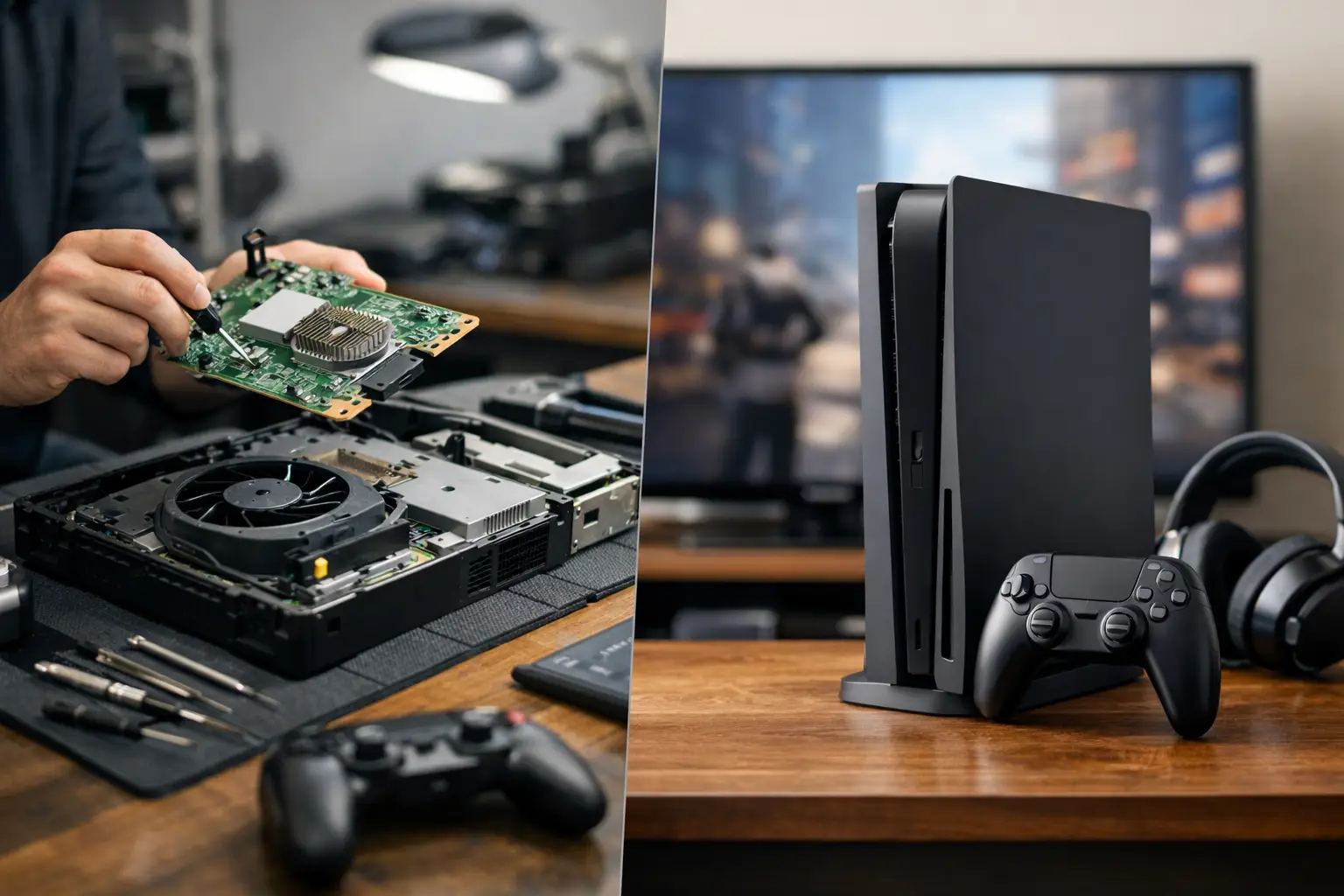
That sinking feeling usually starts with something small – your console stops reading discs, the HDMI port goes loose, it overheats halfway through a match, or it simply refuses to power on. When that happens, the real question is not just what is broken, but whether console repair versus buying new makes better sense for your money, your time and your saved data.
For most people, the answer is not as simple as repair is always cheaper or replacement is always better. It depends on the age of the console, the fault itself, the cost of the repair, how quickly you need it back, and whether a newer machine would genuinely improve your gaming. If you are in Barrow-in-Furness, Cumbria or the Lake District and want a straightforward answer, the best choice is usually the one that gives you reliable performance without wasting money.
Console repair versus buying new – what matters most?
A lot of console faults look worse than they are. A damaged HDMI port, failing fan, power issue or disc drive fault can make a console feel finished, but these are often repairable problems. In those cases, repairing the console can be the sensible option, especially when the cost is far below the price of replacing the entire system.
The biggest advantage of repair is value. If your console is otherwise working well and the fault is isolated to one component, paying for a targeted repair can keep you gaming without the bigger hit of a new purchase. That matters even more if you also need extra controllers, subscriptions or storage, because replacing a console is rarely just the price of the console itself.
On the other hand, buying new can make sense if the machine has multiple faults, has already had repeated problems, or is so old that the repair cost starts creeping too close to replacement value. If a console has severe liquid damage, major board-level failure or signs of long-term overheating, a repair may still be possible, but it may not always be the most economical route.
When repairing your console is usually the better option
If the issue is clearly hardware-specific, repair often wins. HDMI ports are a good example. A port can be bent, snapped or worn out through normal use, and the rest of the console may be completely fine. Replacing that part is usually much more sensible than buying a whole new machine.
The same goes for power faults, noisy or failing cooling fans, charging issues with handheld consoles, disc drive problems and some overheating faults. These are common repairs and, in many cases, they can be diagnosed quickly. If the machine has been reliable up to now and there is no sign of deeper damage, repair is often the smarter spend.
There is also the issue of familiarity. People do not always want to replace a console they know works for their setup, account access and game library. Even when cloud saves are available, not everything transfers as neatly as people expect. If a repair gets your existing console back up and running properly, that can save both money and hassle.
For families, repair can be particularly attractive. Replacing a child’s console after one accident with a cable or a drop can feel excessive when a single-part repair may solve it. For students and everyday gamers, it is often the difference between a manageable bill and an expense that needs to wait.
When buying new makes more sense
There are times when replacement is the stronger option. If your console is from an older generation and you were already thinking about upgrading, a significant repair bill may be the push that makes buying new worthwhile. This is especially true if the newer model offers better performance, faster loading, more storage or access to games your current system cannot run well.
Replacement can also be the better call if the repair is uncertain. For example, extensive liquid damage can affect multiple components, not just the first one that fails. A successful repair may still leave a risk of future issues if corrosion has spread. In that kind of case, the cheapest option on paper is not always the cheapest over the next six months.
Another factor is availability. If replacement consoles are readily available and priced reasonably, some customers prefer the certainty of starting fresh. That is understandable, especially for heavy gamers who cannot be without their console for long. But even then, it is worth comparing the full cost, not just the headline retail price.
The cost question is only part of the story
When people weigh up console repair versus buying new, they often focus only on the upfront number. That is important, but it is not the whole picture. A repair might cost a fraction of a new console, which makes it attractive straight away. But you should also think about lifespan after repair, the quality of the work, and whether the fault has been properly diagnosed.
Likewise, a new console may seem like the cleaner option, but it can bring extra costs. You may need additional storage, a new accessory, a second controller, or even a different display setup to make the most of it. If your current machine can be repaired well and continue performing reliably, replacement can become an expensive answer to a smaller problem.
Good diagnosis matters here. Guesswork leads to bad decisions. A proper inspection can tell you whether the issue is a straightforward fix or a sign of something more serious. That gives you a fair comparison rather than forcing you to choose based on frustration.
Performance, age and expected lifespan
Age matters, but not in the way many people think. An older console is not automatically beyond repair, and a newer one is not automatically worth replacing. What matters is condition and expected lifespan after the work is done.
If a console has been well looked after and only has one clear fault, a repair can still offer good value, even on an older model. If it is clogged with dust, constantly overheating, has visible wear on multiple ports and has become unreliable in general, then spending more money on it may be harder to justify.
This is where an honest repair assessment is useful. A trustworthy technician should tell you if the repair makes sense and if there are signs that the console is nearing the point where replacement will be more practical. That kind of advice saves people from throwing money at a machine that is already on borrowed time.
What local repair changes
Sending a console away often puts people off repair. They worry about long waits, unclear communication and the risk of the device disappearing into a national service queue. Local repair changes that. You can get a clearer diagnosis, a realistic turnaround time and direct answers from someone handling the device.
That local factor is a big reason many customers choose repair first. Fast service matters when the console is used daily, shared between family members or needed for downtime after work or study. A nearby specialist can also explain the fault in plain English, which makes the repair versus replace decision much easier.
At TechLab Repairs, that practical approach is exactly what customers expect – straightforward advice, secure handling and a repair recommendation based on what is actually best value, not what sounds easiest in the moment.
How to decide without overthinking it
If the repair cost is comfortably lower than replacement, the fault is limited, and the console has otherwise been dependable, repair is usually the sensible route. If the machine has multiple issues, serious internal damage or little life left in it, buying new may be the better investment.
A simple way to look at it is this: if a repair gives you a reliable console for a reasonable price and avoids unnecessary spending, it is doing its job. If the repair feels like a temporary patch on a machine that is already failing in other ways, replacement starts to look more sensible.
There is no prize for replacing too soon, and no benefit in repairing too late. The right choice sits somewhere in the middle, based on cost, condition and how you actually use the console.
A broken console does not always mean starting again. Sometimes the smartest move is a clean, professional repair that gets you back to gaming without the cost of a brand-new system. Sometimes it is time to move on. The key is getting the right diagnosis first, then making the choice that serves you best rather than the one that feels quickest in the moment.