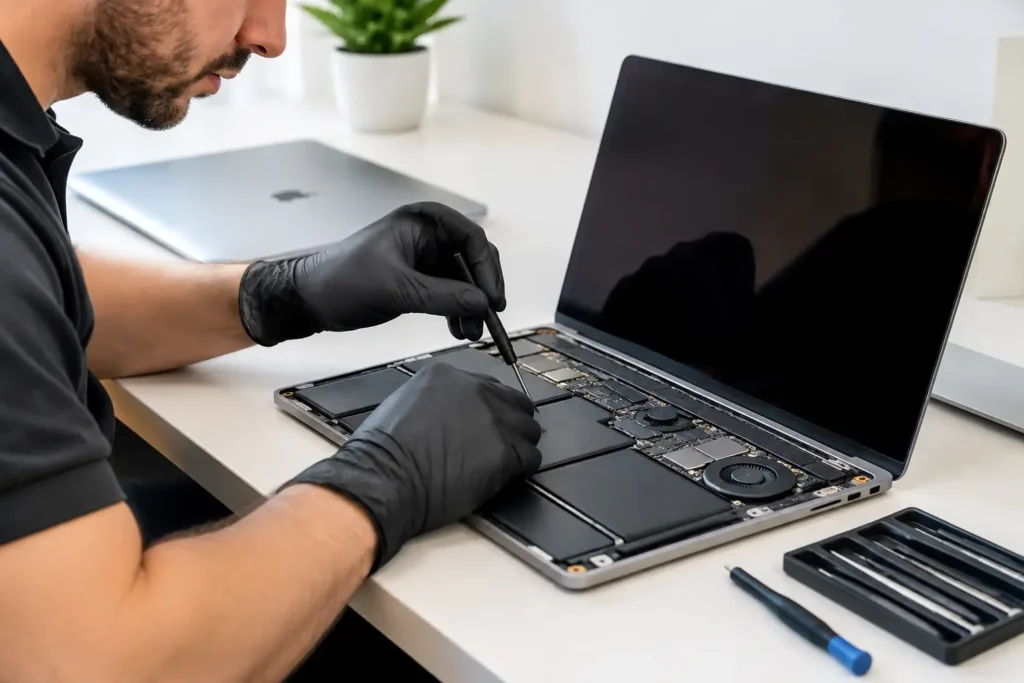
A MacBook can feel old long before it stops being useful. Perhaps it still holds years of family photos, coursework, business files or music projects, but the battery dies by lunchtime, the keyboard misses letters or it refuses to power on. If you are searching for vintage MacBook repair Barrow, the real question is not simply whether it can be fixed. It is whether repairing it gives you a dependable machine for a sensible cost.
For many older MacBooks, the answer is yes. A well-built MacBook with a replaceable drive, tired battery or damaged screen can have plenty of life left. Other faults are more involved, particularly liquid damage and logic board issues. A proper diagnosis makes the difference between spending wisely and putting money into a laptop that is nearing the end of its practical working life.
What counts as a vintage MacBook?
There is no single cut-off point, but most customers use “vintage” to describe MacBooks that are no longer current and may no longer receive the latest macOS releases. That could include a white polycarbonate MacBook, an aluminium unibody MacBook Pro, an early Retina model or an older MacBook Air.
Age alone does not decide whether a repair is worthwhile. Some 2012 MacBook Pros are still excellent machines for web browsing, documents, video calls and everyday admin after a few carefully chosen upgrades. Conversely, a newer model with serious board damage can be a more difficult financial decision.
The model, specification, condition and intended use all matter. A laptop used for email and home banking has different demands from one used for design work, music production or running a small business.
When vintage MacBook repair in Barrow makes sense
The most worthwhile repairs are often those that solve a clear, contained fault. Batteries, screens, storage drives, charging components, fans and certain keyboard issues can transform the day-to-day experience of an older MacBook.
A poor battery does not mean a poor laptop
Battery wear is one of the most common reasons an older MacBook gets left in a drawer. Symptoms include sudden shutdowns, a battery warning, swelling, an unreliable charge percentage or a machine that only works when plugged in.
Replacing a worn battery can make a familiar MacBook portable again. It is especially good value when the laptop is otherwise performing well and suits what you need it to do. If there is any sign of battery swelling, stop using the device and arrange an assessment promptly. A swollen battery can place pressure on the trackpad and case, and should not be ignored.
Slow performance may be fixable
Not every slow MacBook needs replacing. Older machines with traditional hard drives can feel dramatically quicker after moving to solid-state storage. More available storage space, a clean operating system and sensible software housekeeping can also help.
However, there are limits. Storage upgrades cannot compensate for an ageing processor, low fixed memory or software that has become too demanding for the hardware. The honest answer depends on what you need the machine to handle. For light use, a repair or upgrade can be excellent value. For intensive editing, modern games or specialist professional software, replacement may be more practical.
A damaged screen is usually a clear repair decision
Cracked glass, flickering, lines across the display, a dim backlight or an image that only appears at certain angles can point to a screen-related fault. Screen repairs are often worth considering where the rest of the MacBook remains in good condition.
The right assessment matters because not every display issue is the panel itself. In some cases, the cable, graphics system or logic board is responsible. Identifying the underlying fault before authorising work helps avoid unnecessary expense.
Charging and power faults need proper diagnosis
An old MacBook that will not charge or switch on is not automatically beyond repair. The cause may be the charger, charging port, battery, power circuit, keyboard power button or a fault on the logic board.
This is where guessing can become expensive. Replacing parts one by one without testing may not solve the problem. A repair technician should assess how the device responds to power, inspect for signs of damage and explain the likely route before work begins.
The faults that need a careful cost-benefit decision
Some repairs are straightforward. Others need a more measured conversation, particularly if the MacBook is significantly older or has suffered liquid damage.
Liquid damage is a good example. Even when a laptop appears to work after a spill, moisture can start corrosion that causes faults days or weeks later. Quick action improves the chances of a successful repair. Turn the MacBook off, disconnect power, avoid charging it and do not rely on rice to dry it out. It cannot remove residue or prevent corrosion inside the machine.
Logic board faults can also be repairable, but the decision depends on the laptop’s model, current condition and value to you. If the device contains irreplaceable work files, a board-level repair or data recovery attempt may be the right choice. If it already has multiple issues, an alternative device may offer better long-term value.
A trustworthy repair service should be clear about that distinction. You should not feel pressured into a repair simply because the device is on the bench.
Protecting your files during an older MacBook repair
For most people, the data is more valuable than the MacBook itself. Old laptops often contain documents, photographs, passwords, email archives and software licences that have not been moved anywhere else.
If the MacBook still starts, back it up before bringing it in. Use an external drive or a suitable cloud service, and make sure the backup has completed successfully. If it will not boot, tell the repair technician that data is a priority before any work begins.
A repair should not require unnecessary access to your personal files. That said, diagnostics can sometimes require testing the operating system, keyboard, ports, camera or storage. Discuss what is needed, remove sensitive files where possible and make sure you understand the repair process. For business devices, this is particularly important, as commercial data may need additional handling procedures.
Parts quality and repair expectations matter
With a vintage MacBook, the cheapest quote is not always the best value. Older models can require specific parts, and the availability and grade of those parts can vary. A clear repair provider will explain whether a part is new, reclaimed or compatible, and what that means for performance and appearance.
It is also sensible to ask about testing and warranty cover. A replacement battery should be tested for charging behaviour. A screen should be checked for image quality, brightness and camera function. After a power repair, charging and stability should be tested properly rather than assuming the issue has gone away.
At TechLab Repairs, the aim is to give customers a straightforward view of the fault, the repair options and the likely value of proceeding. No one wants to be without a laptop longer than necessary, but speed should never replace careful diagnosis.
Signs it may be time to replace rather than repair
Replacement can be the better option when several expensive faults appear at once. For example, an older MacBook with a failed display, worn battery, damaged keyboard and unreliable logic board may cost more to restore than it is worth for your needs.
Software support is another consideration. If essential apps, security updates or online services no longer work reliably with the operating system your MacBook can run, hardware repair alone will not solve the issue. This does not mean the machine has no value. It may still be useful as a secondary device, for basic offline tasks or after secure data transfer, but it may not be right as your main work laptop.
Before deciding, think about the next 12 to 24 months rather than just this week’s fault. If a modest repair keeps a capable MacBook working comfortably through that period, it is often a sensible and less wasteful choice. If it only delays a bigger problem, putting the repair cost towards a replacement can bring more peace of mind.
Bring the right details for a quicker answer
When booking an assessment, have the MacBook model or serial number if available, along with a clear description of what happened and when the problem started. Mention spills, drops, previous repairs, error messages and whether the device powers on. Bringing the charger can also help with charging and power diagnosis.
An older MacBook does not need to be written off because it is slow, damaged or temperamental. Get the fault assessed, protect the data that matters and choose the option that gives you the best value for how you actually use your laptop.