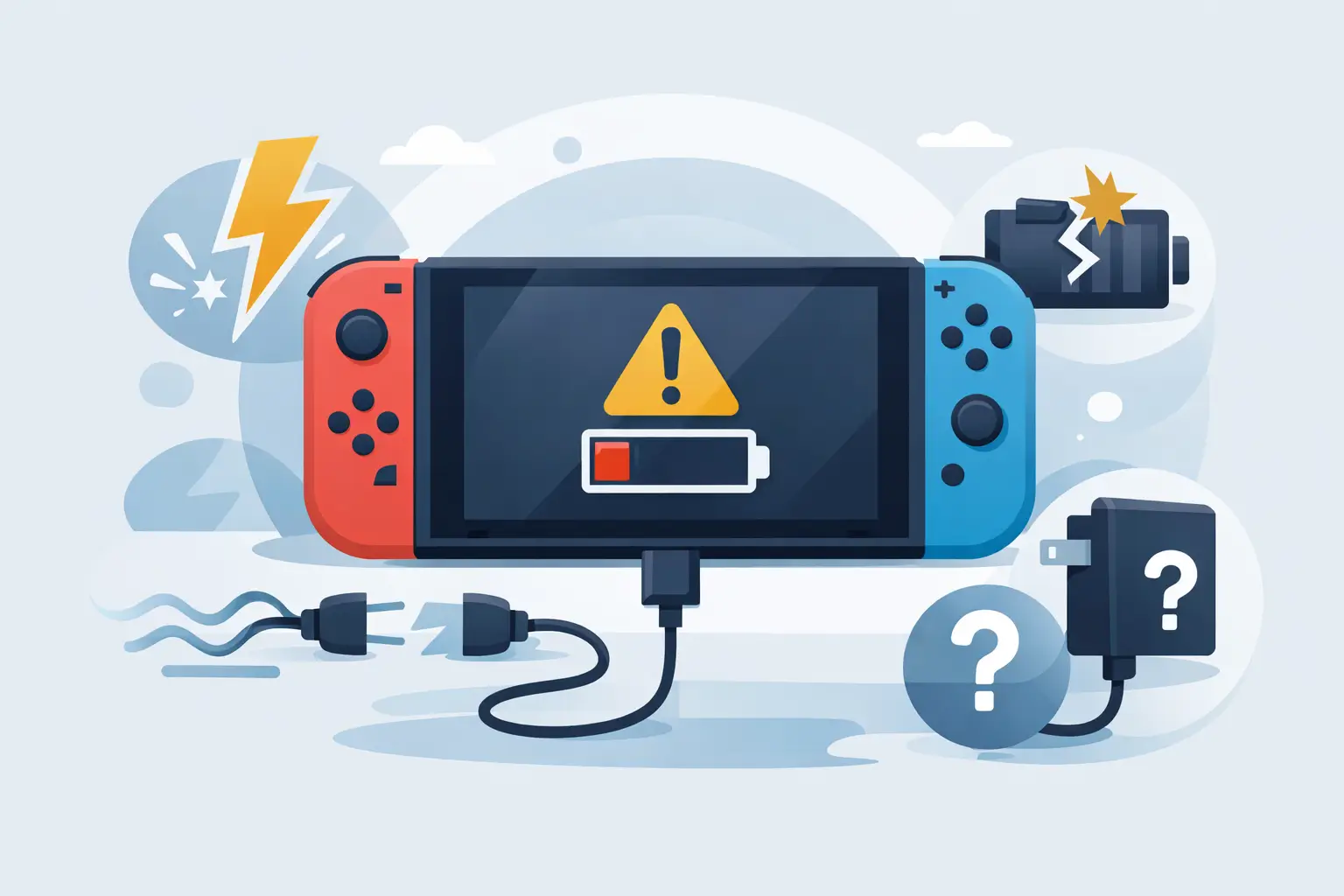
A Nintendo Switch that will not charge is rarely just “one of those things”. In most cases, Nintendo Switch charging faults come down to a small number of causes – a damaged USB-C port, a failing charger, battery trouble, dock issues or a fault on the power management circuit. The tricky part is that the symptoms often look the same, which is why many people waste money on the wrong accessory or assume the console is finished when it is not.
If your Switch has stopped charging properly, the best approach is to rule out the simple problems first and then look at the hardware signs. That saves time, avoids making the damage worse and gives you a clearer idea of whether you need a replacement charger or a proper repair.
What Nintendo Switch charging faults usually look like
Some faults are obvious. The console does not respond at all when plugged in, the battery icon never changes, or it charges only at a certain angle. Others are less clear. It may appear dead after being left flat for too long, it may charge very slowly, or it may work with the mains charger but not through the dock.
Another common pattern is intermittent charging. You plug it in and the battery symbol appears, then disappears a few seconds later. That often points to wear in the charging port or damage to the cable end, but it can also mean the power regulation inside the console is unstable.
Heat matters too. If the console becomes unusually warm while charging, stops and starts repeatedly, or drains even while connected to power, there may be a deeper battery or board-level issue rather than a simple accessory problem.
Start with the charger, cable and socket
Before assuming the console itself is faulty, test the basics properly. The Nintendo Switch is fussy about power delivery, and not every USB-C charger behaves the same way. A cheap third-party lead might physically fit, but that does not mean it is delivering stable power in the way the Switch expects.
Try the official charger first if you have it. Plug it directly into a wall socket rather than an extension lead that might be loose or overloaded. If possible, leave the console connected for at least 30 minutes before judging it as dead, especially if the battery was completely drained.
It is also worth checking the cable for fraying, bent connectors or looseness at either end. Cables often fail before people notice visible wear. If the charger and cable work on another compatible device, that is useful information, but it still does not fully clear them because the Switch can be more sensitive than a phone or tablet.
When the USB-C charging port is the real problem
A worn or damaged charging port is one of the most common Nintendo Switch charging faults we see in repair work. The port takes a lot of strain over time. Children tug leads sideways, consoles are used while plugged in, and docks can put pressure on the connector if the unit is not seated cleanly.
Typical signs include needing to hold the cable at a certain angle, visible looseness in the port, charging that cuts in and out, or no response from known-good chargers. In some cases, the pins inside the USB-C port become bent or contaminated with dust and debris. Even a small amount of compacted fluff can stop the connection from seating correctly.
This is where caution matters. It is tempting to poke inside the port with a pin or metal tool, but that can short pins or physically damage them. If you suspect debris, it needs careful cleaning with the right method. If the pins are damaged or the port has come loose from the board, cleaning will not fix it – the port will need proper replacement.
Battery faults are not always obvious
People often assume a battery problem means obvious swelling or very short run time, but Switch batteries can fail in quieter ways. A degraded battery may refuse to recover from a deep discharge, charge very slowly, report the wrong percentage, or shut the console down unexpectedly even after appearing to charge.
If your Switch has been left unused for a long period, the battery may have dropped so low that the console needs more time than expected before showing any life. That does not always mean the battery is healthy. Sometimes it will take charge temporarily and then start failing again soon after.
Battery issues can also overlap with charging circuit faults. The console may recognise power but not store it properly, or it may show charging on screen while the percentage barely moves. That is why battery replacement should be based on diagnosis rather than guesswork.
The dock can confuse the diagnosis
A lot of owners think the console is not charging when the real issue sits with the dock. If your Switch charges directly from the official charger but not when placed in the dock, the dock becomes the main suspect. That could be due to a faulty dock USB-C connection, internal power issue, or even a problem with the dock’s own USB-C input.
It is also possible for the opposite to happen. The console may appear to charge in the dock but fail to charge reliably through a direct cable because the port is partially damaged and the pressure differs depending on how the lead is inserted.
For that reason, testing both direct charging and dock charging is useful. If one works and the other does not, the pattern tells you a lot. If neither works, the fault is more likely to be the charger, battery, charging port or internal board.
Board-level power faults are more serious, but still repairable
When the charger, cable, battery and visible port condition do not explain the issue, attention turns to the motherboard. The Switch relies on small charging and power management components to negotiate voltage, control battery charging and distribute power safely. If one of those components fails, the console may stop charging altogether or behave inconsistently.
This kind of fault can happen after liquid exposure, use of poor-quality accessories, power surges, accidental drops or simple component wear. Symptoms can include the console drawing no power, showing no life even with a good charger, overheating around the USB-C area, or losing charge rapidly despite a replacement battery.
Board-level repairs are more specialised than a straightforward parts swap. They require proper testing equipment and microsoldering skill. The good news is that a board fault does not automatically mean the console is beyond repair. It just means the diagnosis has to be accurate before any work starts.
What you can safely check at home
There are a few sensible checks you can do yourself before booking a repair. Confirm you are using a known-good charger, ideally the official one. Try a different wall socket. Leave the console plugged in for at least half an hour if the battery was fully flat. Test whether it charges directly but not in the dock, or vice versa.
Look into the charging port with a torch, but do not force anything into it. If you can see obvious debris, that supports the case for a port clean or inspection. Pay attention to whether the cable feels loose, whether charging starts only when pressure is applied, and whether the unit becomes warm unusually fast.
What you should not do is keep trying random third-party chargers, bend the cable while connected to “find the sweet spot”, or keep docking and undocking it if the port already feels unstable. Those habits often turn a repairable port into a more expensive board job.
When to stop troubleshooting and book a repair
If your Switch still does not charge after basic testing, if the port is visibly damaged, or if the charging cuts in and out, it is time for proper diagnosis. The same applies if the console has had liquid exposure, has stopped working after a drop, or becomes hot around the port while connected to power.
For families, students and gamers, the temptation is usually to put up with it for a while. That makes sense if the fix is just a cable. It makes less sense when an unstable charging port can damage the board over time. Early repair is often cheaper than waiting until the console stops powering on altogether.
At TechLab Repairs, this is exactly the sort of fault that benefits from hands-on testing rather than guesswork. A clear diagnosis tells you whether you are dealing with a charger issue, a port replacement, a battery fault or a board-level repair, and that means you only pay for the work the console actually needs.
Nintendo Switch charging faults are fixable more often than people think
A non-charging Switch can feel like the beginning of the end, especially if it has gone completely blank. In reality, many Nintendo Switch charging faults come down to parts that wear out or components that can be repaired. The important part is not forcing a home fix that risks extra damage.
If the console is only charging at an angle, not charging in the dock, draining despite being plugged in, or showing no life at all, there is usually a reason you can track down. A careful diagnosis turns a vague power problem into a clear repair decision – and that is often the point where a “dead” console starts looking worth saving.